Lelit Anita PL042TEMD Review: A Serious All-in-One Espresso Machine for Home Baristas, but Not for Push-Button Convenience

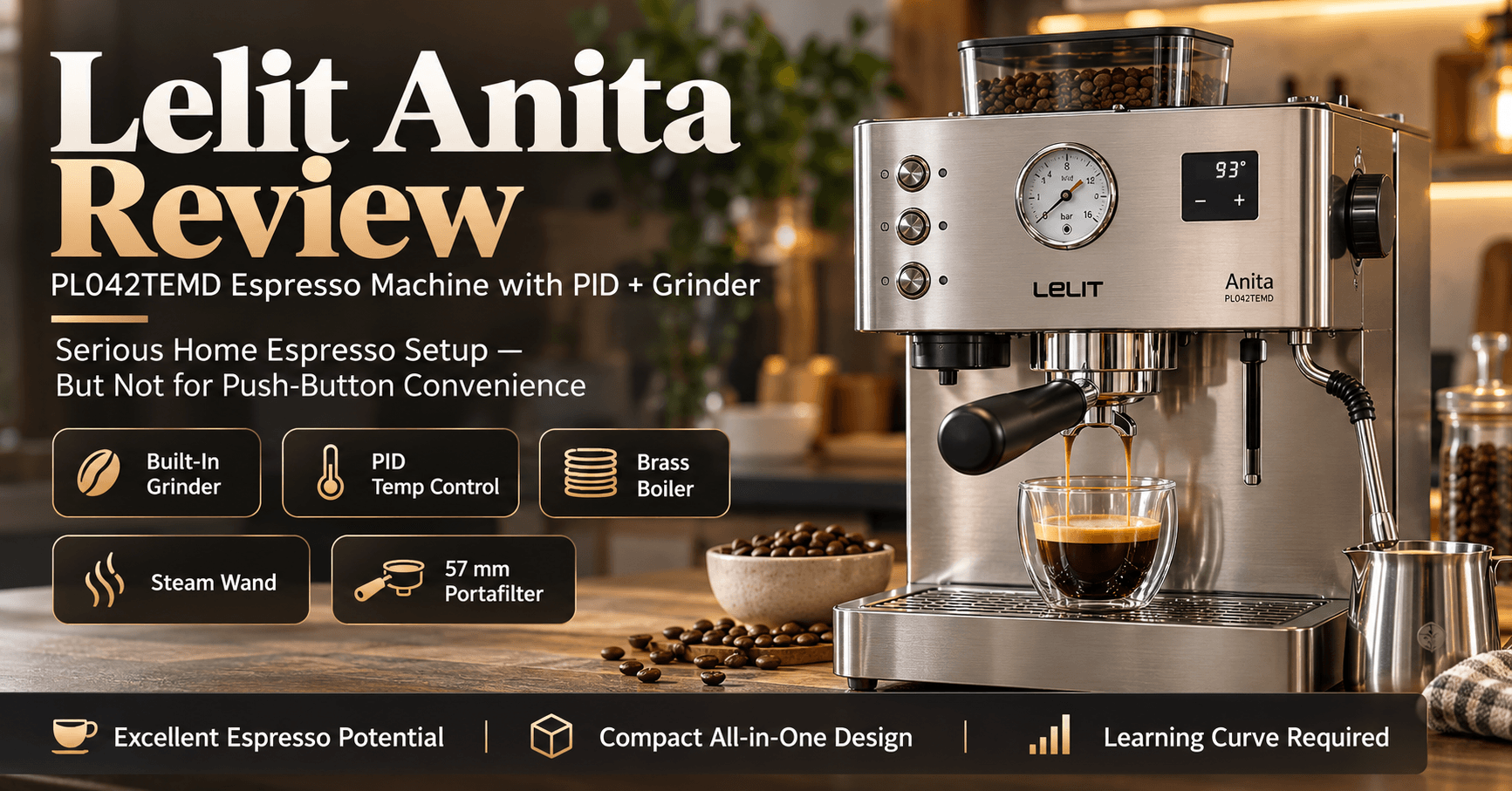
The Lelit Anita PL042TEMD sits in an interesting middle ground. It is not a beginner-oriented pod machine, and it is not a fully automatic bean-to-cup appliance. Instead, it combines a manual espresso machine, PID temperature control, built-in grinder, pressure gauge and steam wand in one compact stainless-steel unit.
That makes it particularly appealing to someone who wants to learn proper espresso preparation without buying a separate grinder and machine.
The supplied Amazon listing showed the Lelit Anita at ₹79,499, with an MRP of ₹89,999.
At that price, expectations should be high. The Anita has the hardware to produce genuinely impressive espresso, but customer feedback makes one thing very clear: this is a machine that rewards technique, patience and maintenance.
If you want to press a button and receive a consistent cappuccino with no learning curve, this is probably the wrong category of machine.
Check the latest Lelit Anita PL042TEMD price on Amazon
The Built-In Grinder Is One of the Biggest Reasons to Consider the Anita
The integrated grinder is not merely a convenience feature.
Freshly ground coffee is central to producing good espresso, and the Anita’s built-in grinder lets you adjust grind size as part of the espresso-dialling process without buying another appliance.
The product page specifically positions the grinder as a space-saving design that is matched to the machine.
That has two practical benefits:
- your countertop stays relatively uncluttered;
- you can grind directly for espresso rather than relying on pre-ground coffee.
Several experienced owners describe the grinder as capable of grinding fine enough for proper espresso, though it takes experimentation to find the correct setting.
One long-term user specifically noted that the grinder needed careful adjustment before the espresso became properly balanced, and another praised its ability to grind finely enough to even choke the machine if set too fine.
That tells you something useful: the grinder is not just decorative. It has enough adjustment range to affect extraction substantially.
PID Temperature Control Is a Real Advantage, Especially for Experimenting
The PID is one of the most meaningful features on the Anita.
The manufacturer describes it as a temperature controller designed to maintain a programmed brew temperature more consistently.
In practical use, that allows you to change brew temperature depending on the coffee.
For example:
- darker roasts may taste better at a slightly lower temperature;
- lighter roasts may benefit from a higher temperature;
- different beans may require different grind and temperature combinations.
Several experienced owners specifically praised the PID because it lets them experiment rather than simply accept one fixed brew temperature.
One Spanish reviewer who had used the machine daily for a year highlighted temperature control as an important part of adapting the machine to different roasts.
For anyone trying to move beyond basic espresso and actually understand extraction, that is a meaningful advantage.
The Anita Can Produce Excellent Espresso, but Technique Matters More Than the Machine Alone
This is probably the most consistent positive theme in the customer feedback.
Once users find the right combination of:
- grind size;
- coffee dose;
- tamping pressure;
- brew temperature;
- extraction time;
the machine is capable of producing espresso that many owners describe as comparable to good café coffee.
One long-term reviewer described experimenting with different beans, eventually finding suitable grind settings and extraction ratios, and producing balanced espresso after adjusting those variables carefully.
The same reviewer later explained that shots around 20–25 seconds worked well for their preferred recipe, while coarser or finer grinds led to under- or over-extraction.
That is exactly the kind of feedback that separates the Anita from automatic machines.
The quality potential is high, but the machine does not remove the human from the process.
This Is Not an Ideal Machine for Someone Who Wants Instant Results
Several reviewers say essentially the same thing in different ways: the Anita has a learning curve.
If your previous coffee experience has been:
- capsules;
- pods;
- moka pot;
- fully automatic machines;
- supermarket espresso machines with pressurised baskets;
the Anita can initially feel demanding.
A good shot requires adjustment.
One experienced Italian owner described it as semi-professional in feel and said it requires some adaptation, particularly for people coming from automatic or capsule machines.
Another reviewer summarized the experience well: the machine can give impressive results, but only after you learn how to control the variables.
That is not really a flaw. It is the nature of manual espresso.
But it absolutely affects who should buy it.
The Single-Boiler Design Creates an Important Workflow Limitation
The Anita uses a single boiler for both brewing and steaming.
That means you cannot brew espresso and steam milk simultaneously.
Instead, the workflow is generally:
- brew the espresso;
- switch to steam mode;
- wait for the boiler to reach steaming temperature;
- steam the milk;
- cool or refill the boiler before the next espresso if necessary.
For one or two drinks at a time, that is manageable.
For someone making several cappuccinos back-to-back every morning, it becomes less convenient than a dual-boiler or heat-exchanger machine.
One reviewer specifically noted that espresso should be prepared first, then the boiler heated further for steaming.
Another owner said the wait between brew mode and steam readiness was relatively short, but the basic limitation still exists.
Steam Performance Is Good When Everything Is Dialled In
The Anita includes a multidirectional steam/water wand.
The manufacturer describes the brass boiler as capable of producing dry steam suitable for fine microfoam.
Many owners support that claim.
Several reviews describe producing good microfoam after learning proper technique.
One experienced owner reported good steam pressure and specifically noted that poor foam can sometimes be caused by the milk itself rather than the machine, especially with some plant-based milks.
Another owner said that after a little practice, the steam wand could create fine-textured milk foam.
So milk drinks are absolutely within the Anita’s capability.
But again, the operator matters.
The Boiler Size Is Also One of Its Main Constraints
The same single-boiler architecture that keeps the machine compact creates another limitation: temperature stability under heavier use.
One experienced owner said the relatively small boiler could lose more than 10°C during extraction and that steam sometimes weakened before milk texturing was complete.
Another reviewer similarly described watching the brew temperature drop during extraction and considered that one of the machine’s compromises at this price level.
This does not mean the Anita cannot make excellent espresso.
It means you should not expect the same thermal stability as a much larger commercial-style dual-boiler machine.
For home use, especially one or two drinks at a time, the limitation is much easier to live with.
Warm-Up Time Is Worth Taking Seriously
The machine may become technically ready relatively quickly, but several experienced owners recommend letting it warm for longer before expecting the best results.
One review suggested allowing roughly 10 minutes for greater temperature stability before extraction.
Another experienced user preferred around 20 minutes, while another suggested that a longer warm-up could improve shot quality even further.
The reason is simple: it is not just the boiler that must heat.
The portafilter, group and surrounding metal also need to reach a stable temperature.
If you make the first espresso immediately after switching the machine on, results may be less consistent.
For regular morning use, putting the machine on a timer can make the workflow much easier.
The 57 mm Portafilter Is Capable, but Less Universal Than 58 mm
The Anita uses a 57 mm filter holder.
That size works perfectly well for espresso, but it is less common than the 58 mm commercial standard.
The practical consequence is accessory availability.
A 58 mm machine gives you an enormous choice of:
- baskets;
- bottomless portafilters;
- tampers;
- puck screens;
- distribution tools.
With 57 mm, compatible accessories still exist, but the range is narrower.
One customer specifically mentioned that 57 mm accessories were less readily available than 58 mm equivalents.
For most users, this is a minor inconvenience rather than a deal-breaker.
But espresso hobbyists who expect to upgrade accessories frequently should know about it before buying.
The Pressure Gauge Is Useful for Learning
The machine also includes a coffee pressure manometer.
This can be especially helpful while learning.
If pressure is too high or too low during extraction, it can help indicate whether:
- the grind is too fine;
- the grind is too coarse;
- the dose is incorrect;
- tamping is uneven;
- the coffee bed is restricting flow excessively.
The pressure gauge does not replace tasting the espresso, but it gives an additional diagnostic clue when dialling in.
For someone new to non-pressurised espresso, that can shorten the learning curve.
The Stainless-Steel Construction Feels More Serious Than Typical Consumer Machines
The Anita’s polished stainless-steel exterior gives it a more traditional espresso-machine appearance than the plastic-heavy construction found on many cheaper appliances.
The manufacturer describes the stainless-steel body as durable and long-lasting.
Owners frequently praise the machine’s appearance and solidity as well.
One long-term reviewer described the body as robust, attractive and relatively easy to clean.
That matters at ₹80,000.
At this price, buyers should expect something that feels more like equipment than a disposable kitchen appliance.
The Anita largely meets that expectation.
The Compact All-in-One Layout Is a Major Advantage for Small Kitchens
A separate grinder and espresso machine can easily take over an entire section of a countertop.
The Anita combines both in one body.
The manufacturer specifically markets the compact footprint as one of its advantages.
That makes it particularly attractive if you:
- live in an apartment;
- have limited counter depth;
- want a cleaner coffee station;
- do not want separate power cables and appliances.
This is one of the strongest reasons to choose the Anita over a separate grinder-and-machine setup.
The compromise is that if either the grinder or espresso machine develops a fault, both functions are physically tied into one unit.
Cleaning and Maintenance Are Part of Ownership
The Anita is not maintenance-free.
Manual espresso machines need regular attention to:
- group-head cleanliness;
- portafilter and basket cleanliness;
- steam-wand hygiene;
- grinder cleanliness;
- water quality;
- descaling or scale prevention.
Several experienced owners specifically mention routine cleaning as necessary for maintaining good coffee quality.
One long-term user recommended flushing the group briefly between shots.
Another reviewer noted that a blind filter for backflushing was not included and had to be purchased separately.
That is a small omission, but it matters if you intend to maintain the machine properly.
The Warranty Conditions Deserve Particular Attention in India
The Amazon listing states a 1-year warranty.
But there is also a very important warranty-related note in the listing.
It says that warranty coverage may be void if the machine is not used with RO water and a voltage stabilizer with high/low trip protection.
That is not a minor detail.
Anyone buying this machine in India should take that requirement seriously and confirm the exact warranty conditions with the seller before purchase.
Water quality is especially important for espresso machines because mineral scale can damage boilers, valves and heating elements over time.
A proper stabilizer is also sensible protection for an ₹80,000 appliance.
Customer Satisfaction Is High Overall, but There Are Some Serious Negative Experiences
The Amazon page shows 412 global ratings, with:
- 71% five-star;
- 9% four-star;
- 4% three-star;
- 3% two-star;
- 13% one-star.
The overall rating is 4.2/5.
That is generally positive.
Many long-term owners describe excellent espresso, strong grinder performance and satisfying milk texturing.
But the negative feedback is not entirely trivial.
Some India-based reviews report:
- poor frothing;
- temperature problems;
- loose electrical plugs;
- dissatisfaction with after-sales handling.
There are also isolated international reports of machines arriving dirty, scratched or apparently previously handled.
Those complaints do not outweigh the overall positive pattern, but at this price it is sensible to inspect the machine carefully on arrival.
A Machine Arriving With Coffee Residue Is Not Automatically Used
Several buyers mention seeing coffee traces when opening the box.
One review explains that the machine may have been factory-tested before packaging and that some residue does not necessarily mean it was previously owned.
However, there are also customers who reported substantial coffee grounds, water marks or scratches and suspected a returned unit.
The practical approach is straightforward:
- small traces consistent with testing may be normal;
- obvious scratches, damaged packaging or heavy residue deserve closer inspection.
At ₹79,499, buyers should not feel obliged to accept a visibly used or damaged unit.
Who Is the Lelit Anita Really For?
The Anita is best suited to someone who enjoys the process of making espresso, not just drinking it.
It makes sense if you want to:
- learn to dial in a grinder;
- experiment with temperature;
- adjust dose and tamp;
- practise milk texturing;
- make café-style espresso at home;
- avoid buying a separate grinder;
- keep the setup relatively compact.
It is particularly attractive as a step into serious home espresso because the built-in grinder removes one major purchasing decision.
Who Should Probably Avoid It?
The Anita may frustrate you if you primarily want:
One-touch convenience.
This is a manual espresso machine, not an automatic appliance.
Several milk drinks back-to-back.
The single boiler means brewing and steaming happen sequentially.
Zero learning curve.
Good espresso depends heavily on grind, dose, tamp and temperature.
A completely maintenance-free appliance.
Regular cleaning and water management are part of ownership.
A standard 58 mm ecosystem.
The 57 mm group limits accessory choice somewhat.
Commercial-level thermal stability.
The compact boiler has real limitations under sustained use.
Is the Lelit Anita Worth ₹79,499?
The answer depends heavily on what you value.
If you compare it to a basic ₹15,000–₹25,000 espresso appliance, the Anita is expensive.
If you compare it to buying:
- a capable manual espresso machine;
- a proper espresso grinder;
- PID temperature control;
- pressure gauge;
- stainless-steel construction;
then the price starts to make more sense.
The machine’s real value is in combining those capabilities into one compact system.
View the Lelit Anita PL042TEMD on Amazon and check the current price
Lelit Anita PL042TEMD Review Verdict
The Lelit Anita PL042TEMD is not the easiest espresso machine to own, but that is also part of why it is capable of producing better coffee than many automatic alternatives.
Its strongest features are the combination of a built-in espresso-capable grinder, PID temperature control, brass boiler, pressure gauge, 57 mm portafilter and steam wand in one compact stainless-steel body.
Customer feedback suggests that once the grinder, dose, tamp and temperature are dialled in, the machine can produce genuinely excellent espresso and fine-textured milk.
The trade-offs are equally clear:
- it takes practice;
- the single boiler slows milk-drink workflow;
- temperature can fall during extraction;
- 57 mm accessories are less common;
- maintenance matters;
- warranty conditions in India should be checked carefully.
For someone who wants café-style espresso at home and enjoys learning the craft, the Anita makes a compelling all-in-one package.
For someone who wants coffee quickly, consistently and with minimal involvement, a fully automatic machine would probably be a better fit.
Check current availability and customer reviews for the Lelit Anita on Amazon
At around ₹80,000, the Anita should be bought as a serious coffee tool rather than a convenience appliance. If that is exactly what you want, its blend of grinder, PID control and manual espresso capability is much easier to justify.
Take a closer look at the Lelit Anita PL042TEMD before buying
